Tuesday, November 11, 2014

Anna Film Review

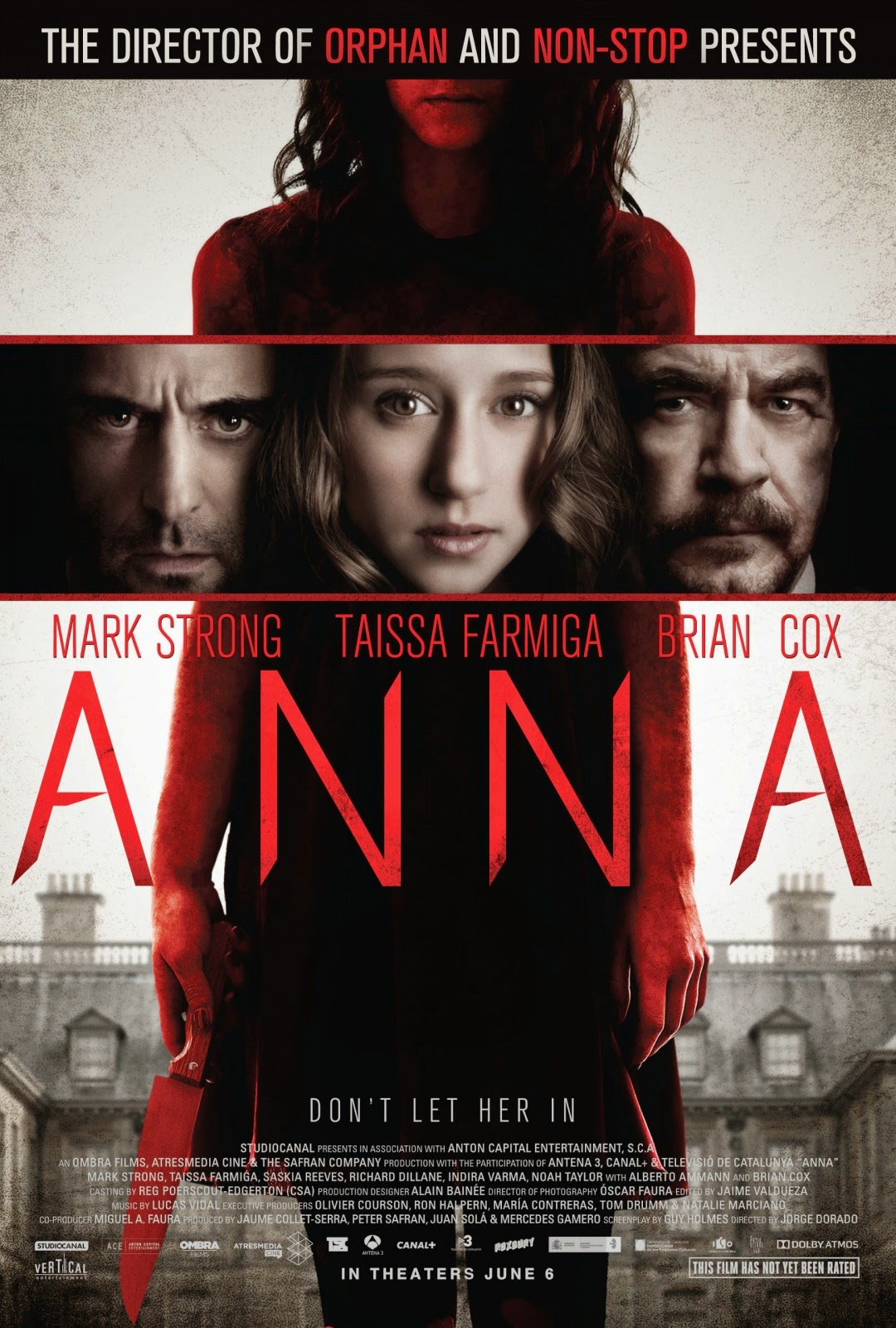
Anna is a psychological thriller that uses the femme fatale trope as a tool for manipulation.  The film first opens to a brief description of a memory detective named John (Mark Strong).  As is common with every other film led by a male, his story doesn't begin until the death of prominent figure – in his case his wife.  As he is propelled into motion, one wonders why the film is titled Anna when the film is mostly from his perspective. 

I was hoping, from the title, there would be a complex female character that could illuminate on mental illness, but in reality Anna’s (Taissa Farmiga) characterization tethers back and forth between victim of abuse and a manipulative, sociopathic teenager constructed as a “seductress.” 

I was initially excited over the more sci fi aspect of a memory detective ala minority report, but the film fell short as it tried to also color the characters with a fatal attraction trope.  The idea that a female is using her “feminine charms” to tempt a man – older than she – to hatch an elaborate escape plan is a tired twist. 

Further, the film tries to explain – rather weakly – Anna’s mental instability by showing John googling “teenage aggressiveness and sexual seduction.”  As if Anna is – as a female – not allowed to own her body without it being hypersexualized by patriarchal conditioning. 

The film, in its attempt to force a twist, exploits Anna’s femininity while making her a secondary, supporting character.  John is essentially the lead that is depicted being conned.  The story is more about his journey of unintended self discovery than it is about Anna’s extreme form of survival. 

What is dangerous about this perspective of overt sexualization of teenage girls and even adult women, in narrative plots, is the use of their bodies as weapons.  When weaponizing female bodies’, violence towards them is easily justified because women become commodified objects to be dominated.  The female body is then seen as a territory to be colonized and conquered. 

The point I am trying to make is goes beyond the film itself, but the film helps facilitate the fact that our society fears the female body so much that it makes it the prime villain in a world where men are considered the heroes. 


I do not recommend this film, though it is available on Starz on demand if you have ixfinity.  

Friday, November 7, 2014

Sleeping Beauty Review: Not your Disney Version

Emily Browning as the "Sleeping Beauty"
Sleeping Beauty, the 2011 Australian drama, is a provocative film that explores gender, class, and sexuality in a unique narrative.  Lucy is a struggling college student attempting to make ends meet.  Like most college students, Lucy has multiple jobs.  However, minimum wa
ge is not enough to make rent so she capitalizes on her body by exchanging sex for money.  What makes this film unique is the company she involves herself in.  Answering an ad in the paper, Lucy is hired to cater exclusive and elite dinner parties….in her lingerie.  My first reaction: is this what rich people do with their time and money?  As someone who has never had much money it baffles my mind when excess waste is done by the rich.  But the more pressing matter is that of female agency and male domination. 

First, “Sleeping Beauty” is not just a title, but a metaphor for female passivity.  The world, at large, expects women to adhere to certain, universally accepted, stereotypes.  Such stereotypes include a demur, soft-spoken, “good girl” behavior.  Historically, women’s bodies have always been considered property.  Even after society, in shifting their mindset to adapt to changing times, accepting a woman as her own person not only disrupted, but threatened the status quo.  What the film shows is, regardless of milestone victories that favored women, their bodies have always been, and continue to be lucrative commodities. 

Selling sex, whether legal or illegal, is a billion dollar business that perpetuates what Naomi Wolfe calls “The Beauty Myth.”  A woman’s value in society, today, is reflected in the value of her looks.  A youthful body of a woman becomes the property of society, and by default the property of men.  But this type of property value is driven by capitalism.  Money is imperative to survival and Lucy does what she can, in her circumstance, to survive.  One way she does is become a “Sleeping Beauty.”  She gets paid, in freelance opportunity, to go under a sedated state while wealthy clients pay to spend the night with her.  A precept explained by the madam to each punter (there are three in total during the film.  All of whom are in old age) states a no penetration policy. 

My fascination with this kind of business is not the selling of sex, but that in the desired motionless acquiescence of the female body.  Lucy’s full participation is not needed or even required for the punters.  Though there is no penetration allowed, the close, intimate touching of Lucy’s body indicates a sense of control and domination exerted over the female body. Even her name change – Sara – is a strong indication that her identity is not her own regardless of her involvement, and that she must be stripped, both figuratively and literally, of her personhood. This brings me to my second point: total masculine supremacy as the ultimate appeal. 

The first punter, before he begins his session, looks to the madam and explains a long, drawn out story – bordering on drivel – how he did very little to cherish the things in his life.  I was looking for a philosophical meaning for his choice, but what I found in his gibberish is a mindless justification for his eccentric payment.  The camera focused on the old man as he broke the fourth wall to center his attention directly at the audience.  I suspect this was done so that we could empathize with him, but it induced nothing in me that had me convinced the circumstances involved were justified.  However, the madam tells him, “You are safe here.  There is no shame here.  No one can see you.”    This is done to validate the old man’s choice.   

The madam, in her own words, gives permission for the old man to take ownership of the “Sleeping Beauty.”  In doing so, the madam invites the audience to do the same, as if the masculinity of the audience also hinges on this archaic notion of domination.  I find the fact a woman – the madam – condoning the violation of another woman, compelling.  It is as if she, speaking for all women, is pardoning the sexual prowess of these older men that with their wealth and privilege buy back their manhood when they buy time with an immobile female body. 

The third punter attempts to lift Lucy in his arms as if he is carrying her over a threshold.  I interpret this as his attempt to prove his masculine worth.  His manhood hinges on his ability to show strength.  Yet, it becomes clear, as he drops Lucy to the floor he is not the same man as he was in his youth, and thus failing to confirm his machismo nobility.  Nothing more is shown of him. 

The second punter, which I kept for last, is a fascinating, but scary subject.  His expression of masculinity is more aggressive and violent.  His verbally abusive tone suggests a type of domination that is more pervasive and common in society.  Men like the third punter desperately try to hold on to their power and sexual aptitude, especially as they age, by exerting brutal and savage behaviors.  In his scene the third punter not only burns Lucy with a cigarette – something that is against the rules – but since he is not allowed to penetrate her vaginally or anally, he violates her by inserting his fingers in her mouth as he calls her a slew of pejorative words.  Lucy is no longer a “Sleeping Beauty” but an object of this man’s verbal and physical abuse, and she is unable to participate or consent as most sex workers might be able to.


Filmmakers tries to push the envelope when it comes to blurring the lines between sexual pleasure and rape, and or what constitutes as sex work, but it is safe to say that the lack of consent of the “Sleeping Beauty,” despite pursuing this unorthodox job herself, she is nothing more than a vessel for patriarchal entitlement.   The film, itself, is worth the watch; its slow pace and drawn out shots linger to give the audience a sense of Lucy’s slow progression as she navigates through her journey.  I enjoyed the film, and suggest it as one of my Netflix picks.  

Tuesday, November 4, 2014

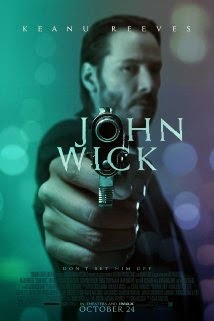
John Wick Film Review: The Flame that is Keanu Reeves

John Wick: Don't Set him Off
It seems that in almost all films with male leads, particularly revenge stories, the male is always motivated to tap into his carnal, violent side, which is prompted by the death (or murder as my previous review on Horns indicated) of his significant other – almost always a woman.  In the case of John Wick, his wife has barely a few minutes of screen time before she is killed off, presumably by a longtime battle with a disease.  Helen (Bridget Moynahan), before her death is assumed to have arranged a gift for her widowed husband.  Posthumously, John receives a puppy from his late wife that he aptly named Daisy. 

Daisy is a clever plot device that represents the presence of his wife without having a woman on screen.  When John has a tiff with a couple of Russians outside a gas station, they decide, boldly and naïvely to “set him off.”  Lead by Iosef Tarasov (Alfie Allen) the son of Russian mobster, Viggo -the Russian version of the most interesting man in the world (Michael Nyquist), they enter his home, kill his dog, and steal his car.  Inept Iosef – a boy trying to fill a man’s shoes – has no idea he just awakened the beast.  Keanu Reeves never looked better in black then he does in this film; draped in form fitting suits that fasten like armor, John Wick inflames the whole assassin community in search of his revenge.

The film plays out like a video game with no hesitation to the violence enacted.  The body count rises at each turn of the corner with no remorse.   One cannot help but wonder, with violence such as this often normalized is masculinity constructed to accept male aggression as innate?  John Wick shows very little compassion and even less emotion – an expected trait in assassin films.  But while this style of storytelling is compelling to watch on screen the fact that there is an expectation in our society, for males to express a detachment of humanity is frightening. 

As much as I enjoyed watching Keanu Reeves take down the villains with blatant disregard, the image of male power encased in violent acts defines masculinity with a sense of brutality, bloodshed and a destructiveness that has little room for anything else.  The film seems, on the surface, simple enough, but liberation from gender roles is not just for women.  Men desperately need to learn how to deconstruct the rigid stereotypes in order to navigate in healthy ways not just with women, but with other men too. 

Most action and thriller films are heavily violent, but most of that violence is male against male.  We don’t think twice about the consequences as being socially deadly, but when the patriarchal system we live in condones bestial clashes between men, and defines them as a normal part of manhood, we inadvertently create an unsafe environment for people. 


Overall, John Wick, the film, is decent as any action film.  It is superficially entertaining, and deeply educational on a sociological perspective.  John Wick, the man, is an anti-hero with very few layers of complexities.  Yet, you root for him up until the end.  

Monday, November 3, 2014

Horns Review: what I learned about female agency

Daniel Radcliffe as the horned, Parseltongue Diablo
On the surface Horns appears to be a murder mystery with heavy religious themes.  Daniel Radcliffe plays Ig Parrish, a sloppy, washed up townie looking to exonerate himself from the death of his girlfriend Merrin (Juno Temple).  In the middle of his predicament, Ig unexplainably grows horns, which allow him, in a town that scourges his every move, to be privy to the deepest and darkest of sins looming within each character he comes into contact with. 

The Horns are a personification of humanity’s true nature; a devil mask that reveals what we want to see of others.  The town views Ig as a devil for what they believe he did to Merrin, but as the film progresses, confession after confession the town-folk illuminate their own sins.  Harboring their own demons, they give way to gluttony, to vanity, to selfishness, to envy, and wrath and so on. 
The film slips back and forth between the present and past tense as Ig uses his horned abilities to ascertain the true details of Merrin’s death.  The film is fresh and original as one can be as an adaptation of a novel.  The Diablo transformation is unique to an otherwise standard Hollywood creation, playing with the same cliché tropes.  Good vs. Evil, female purity, and the ever tired plot device that requires the female love interest to die in order to propel the story of the male protagonist into motion.

However, there were two things that stood out the most; one, the lack of personhood and agency afforded to the character development of Merrin allowed for two, the possession of Merrin’s identity catered to male entitlement in frightening and fatal ways.   The film, Horns, does not actively seek to play on the real anxieties many women face in today’s culture, but it contributes, as an example, of the strict and rigid expectations of gender roles.

On the surface, Ig and Merrin’s relationship seems ideal.  Childhood sweethearts that appear to have a impenetrable romance, but the toxicity of their relationship is not from strange, uncharted territories, but in fact, from the prescribed gender roles assigned.  From the start Merrin is pitted against another female character, Glenna Shepherd.  The two have no on screen interaction, but are, in juxtaposition, biblical opposites.  Merrin is the good virginal woman that all the main male characters vie for while Glenna is reduced to the town slut.  That the two characters cannot coexist as separate and autonomous entities without being boxed into the Madonna/whore complex is a major problem.  For too many reasons I cannot write here, giving women equality would disrupt the status quo.  Neither woman was allowed ownership of her own body.   

When Merrin decides to break up with Ig, her motivation is that of self sacrifice.  However, on the surface, Merrin is believed to have acted on selfish impulse.  But choosing not to disclose the true reasoning leads Ig to wrongfully assume she was leaving him for another man, which induces his jealousy.  The surly behavior Ig exhibits at the diner is curiously revealing.  Ig is passionately stubborn about his relationship, and it borders near obsession.  His whole life, since meeting as children, has centered on Merrin.  He has no concept of an identity beyond their romance.  As his ire increase it becomes apparent that he is more upset at losing his picturesque ideal that anything else.  That he was quick to accuse Merrin of being unfaithful – a claim for which there is no evidence – suggests a sense of ownership of her body.  This is not love. 

Love, in the same regard, is also not what Lee (Max Minghella) exhibits for Merrin.  Though he has been Ig’s best friend since they were all kids, he too has been passionately stirred by his friendship with Merrin.  Lee comes across as a well mannered, diligent good guy, but in the later part of the film it becomes very clear that his crush on his best friend’s girlfriend is not only unhealthy and obsessive, but dangerous and fatal.  What makes Lee dangerous is his clean cut expression of masculinity.  The film does its best to create suspects out of everyone but Lee, which gives him a sense of privilege that society condones.  Yet, Lee is a textbook sociopath that takes advantage of his friendship with Merrin, and completely disregards her personhood as well as her boundaries.

When Lee stumbles upon a distraught Merrin in the cold, rainy night rather be a friend she could trust he makes a pass at her.  Agitated by his brazen behavior, Merrin defends herself by pushing him off.  But, years of obsessive love, built on this notion that Lee has always had possession of Merrin by virtue of fixing her broken cross when they were kids, comes to a boiling conclusion as he is denied access to her body.  Fed up, Lee infringes upon years of friendship, and savagely rapes her, forcing his claim of property, as that is what she has now become, he then murders her viciously and violently. 

Merrin’s death could be classified as a “crime of passion,” but in truth this one act is not an isolated incident.  Though only a film, adapted from a novel, Horns reveals how toxic patriarchy really is.  In no place of the film does Merrin or her body belong to her.  She becomes an extension of identity for each male in the film.  First it is her father, he is over protective.  Then it is Ig; neither, from childhood to young adults, knows a life without each other.  Then, in her worst moment, Ig’s brother makes an uncomfortable pass that prompts Merrin to abandon a possible safe passage home for the darkness of the woods.  And just when things couldn’t get worse, they do.  She believes she has found solace, at last, when Lee finds her, but he is neither a friend nor a safe place to rest. 

After her murder, Ig discovers a letter she had written to him.  In it she finally reveals the truth to why she broke up with him.  She had been stricken with the same kind of cancer that had killed her mother, but rather tell him up front she complicates the situation, hoping it would be an easier to push him out like a baby bird to fly on his own.  Even when she is faced with the scariest thing in her life she doesn’t belong to herself either.  She belongs to the cancer in her body.   And as the failings of hyper masculinity engulf Merrin in violence, her own body traps her life a wounded animal shot in a hunt.  The only thing that remains of her is the tree house, now turned into an effigy, and the scene of the crime, which really belonged to Ig and Merrin both. 

The reason I make a big deal about this lack of characterization of Merrin is that our society rarely affords women the freedom of personhood without attaching their entire identity to a man.  It is most evidenced in film, though it may be subtle at time.  Further, the idea of females as property creates a scary environment where men feel entitled to women’s bodies.  In recent years we have seen an increase of violence against women in various forms.  A teenage girl was stabbed to death after decliningan invitation to prom, a young man went on a killing spree after posting a misogynistic rant on youtube, and most recently, female video-gamers have been receiving a deluge of rape threats and mass shootings in what is being calledgamergate.  Street harassment videos are also highlighting the various experiences of women who just walk down the street, which I need to add is a universal experience as this video from Egypt show.


The point to all of this is that while, the film Horns, on its own, is a decent film with actors we can all love, it does serve a purpose beyond the mise en scene.  It can illuminate as well as contribute to the stressful environment that women and men face when navigating through a patriarchal society.  
Wednesday, October 29, 2014

Odd Thomas Film Review: In Odd we Trust

For those looking for a more supernatural base that is more witty and creative rather than eerie and spooky, Odd Thomas is a well done fun ride.  The twist is easy to spot, but it won’t matter because the heart of the film centers on the Protagonist, Odd, (yes, that is his name, and yes he’ll make a point to tell you) and his girlfriend Stormy. 

Odd is, much like his name suggests a nontraditional hero.  Unlike the super souped up crime fighters of the superhero universe, his strength is more intuitive and less muscle mass, and his supernatural ability to see dead people provides him a sense of vigilante action that will allow him the chance to save the little California town he lives in.  

The film immediately springs into action and is not conservative about taking its time with slow dialogue.  It usually takes ten minutes of screen time to set up universe of a film, but with some quick step the filmmakers of Odd Thomas were able to clue the audience in with just three minutes before the first inciting incident.  It is a heartfelt and emotional film that has the ability to captivate the senses. 


Based on a mystery thriller novel by Dean Koontz, Odd Thomas is a fun Halloween film that follows a young man as he plays “detective to dead people,” the way he puts it.  The supernatural clairvoyant is everything I wish the kid from the sixth sense grew up to be. Anton Yelchin is strong and powerful and poignant in his performance.  There is no much to say about the film other than it is another Netflix pick for some Halloween fun.  

Contracted Film Review: My Netflix Pick

At first glance Contracted seems like a cautionary tale about the dangers of sexually transmitted diseases.  It is not.  The ostensible twist does not come until the end, but to start the film, it opens to a medical examiner raping a dead corpse.  Already the visceral senses are made uncomfortable, and you question if this is just another gratuitous and unnecessary shot for shock value.  I say this because the film makes no attempt to disclose any first person account as to who this man is beyond that opening scene. 
He remains faceless even when he meets the female protagonist, Samantha, who is left inebriated at a friend’s party.   It isn’t a stretch of the imagination when the unknown male rapes Samantha, and in a fait accompli, sets in motion the next three harrowing days of this woman’s life.   We are lead to believe that whatever this woman contracted it was this blurred figure that passed it along, making her patient zero.

Scary Halloween films usually consists of creepy monsters, evil, sadistic, often supernatural psychopaths on a murder spree, and a lot of melodramatic acting.  What makes Contracted scary is the opposite.  While it is possible to outrun a murderer, even a supernatural one, one cannot outrun the failings of the body.  The virus, still unknown to Samantha, takes on a physical toll.  There is copious blood loss, teeth following out, nails coming off, and the occasional slew of maggots dripping out of the vagina.  The fear is heightened by the unidentifiable decent into a maddening disease that which has no name.  It is not a demon that can be exercised.  It is not a masked madman that can be killed.  It has no face, but the one that belongs to Samantha.
With no scientific explanation to hold the weight it is up to the film’s lead actress to give a convincing performance of a fractious mind deteriorating in physical form.  Navigating through an already complicated life, Samantha, played assuredly by Najarra Townsend, starts to lose everything she loves. 

What I disliked, though I cannot hold against the film, is that Samantha’s sexual orientation was vilified by her ex lover, Nikki.  The film does not make it clear if she is a lesbian or a bisexual, but what is clear is that sexual relations with men makes a woman contaminated and repulsive, as a scene between Samantha and Nikki fighting implies.  It is an unfair assessment, but one I find that occurs within the LGBTQA community.  Take the words of out bisexual Megan Fox – when stating her bisexuality she said she would not date a bisexual woman because “that means they also sleep with men, and men are so dirty that I’d never want to sleep with a girl who had slept with a man.”


With this quote in mind, perhaps what became an unintended theme of the film centers on the female body; the virus inflicted on Samantha becomes a personification of the loss of agency and personhood.  And succumbing to the virus is a more deeply frightening personification of living under a toxic form of patriarchy.  Samantha’s sexuality is used against her as punishment not just in being raped by a man, discriminated by her female lover, but that she is, by default, a virus too.  In any case, Contracted is a fascinating, but narrow perspective of a subgenre of a genre.  I recommend this as my Netflix pick for horror films to watch on Halloween.    

Thursday, October 16, 2014

The Boxtrolls: Better Parents than Actual Humans

The Boxtrolls: Eggs, Winnie and Fish
The Boxtrolls is a stop motion animation film for children with surprising adult themes.
Parenting is not an easy venture, but in the film the contrast between two different worlds is a fascinating axiomatic observation.  Juxtaposed on screen are the merger of an aristocratic society and the gutterpups of the underground – the boxtrolls.  In a tangible, contiguous glimpse, the film brings two worlds together to shows us the variation in environmental development of childhood.
Winnie, the town council’s daughter, and Eggs, the boxtroll child are raised in extreme difference.  Winnie has everything money can buy; she is well fed and living in a palatial home.  All things are given to her in ways the less fortunate can only dream of.  Yet, she is missing the most valued and cherished thing a child needs: Parental guidance and love.  
Love is what the boxtrolls encase Eggs in.  Despite living in the catacombs of the underground they have made a home with a mélange of items that fills the usually damp place with familial warmth.  They provide Eggs with the attention he requires and allow him the agency to discover the ability of creation in artistic ways from materials the above ground society calls garbage.  In many ways Eggs is raised as an equal to the boxtrolls.  They love him enough to nurture him as a living being, in doing so he sees the world in a soft, good natured way.  He sees beyond the so-called monstrosity the town labels the boxtrolls in a caveat of annual entertainment. 

For Winnie, the opulence she is privileged with leaves her in unloved isolation.  She acts out in obstreperous rebellion to garner the attention of her absentminded father, and unlike Eggs, is treated as an inferior being that is not only incessantly talked down to, but neglected as well.  Her father is too busy being an ostentatious, cheese loving blueblood to notice her pleading behavior. 
With no parental guidance, Winnie learns to adopt the ferociously prejudiced thinking of the town.  When she meets Eggs she spews, in non sequitur haste, what the town believes to be true of the boxtrolls, but as the notion is proved false, the shift in the story reveals to Winnie what the audience already knows.  The real monsters that prey on the fear of others are adult humans. 


There are different ways to interpret the film, but one thing is quite clear.  The boxtrolls are lovable creatures with a childlike sensibility; each one unique in style and personality.  Children of all ages will love this film as well as any adult.  Stop motion animation is always a wonderful treat to enjoy given the painstaking time each movement costs, and so with that I say, while the film does not pass the bechdel test, it is still worth a watch or two.